CORE & Heat Training
Since the start of the 2025 season I have been working together with CORE, a company that has developed a sensor to measure your skin & core body temperature while exercising. In this post I will share some basics on the CORE sensor and heat training in general, and go into detail on how I used heat training for three major races in 2025.
Get your CORE sensor here.
CORE & Heat Training explanation
The CORE product is crucial to properly do heat trainings. Heat trainings can serve two purposes: to create longer term adaptations which lead to increased performance in general (even in the cold!), or a more short term focused approach to acclimatise for a race in hot conditions. CORE helps with realising this by combining their sensor and algorithm-based app. The sensor measures your skin temperature and gives a precise estimate of your core temperature. The combination of these two results in a certain heat strain index (or HSI): a number illustrating how hot your body is. Interestingly, it takes more than the often mentioned 38.5C core temperature to have a good heat stimulus. I found to have reached these high internal temperatures quite often while training in cool conditions. The real challenge (and heat training benefits) lie in having this high core temperature with a high skin temperature. The body then struggles much more to get rid of its heat.
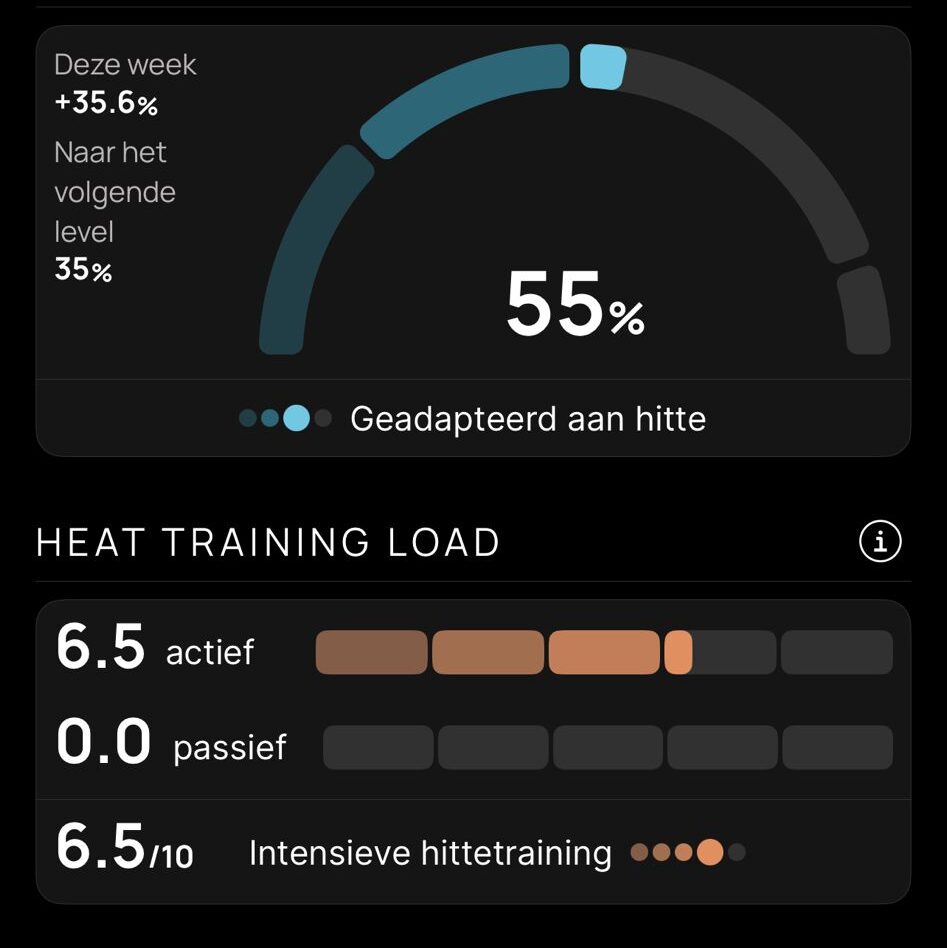
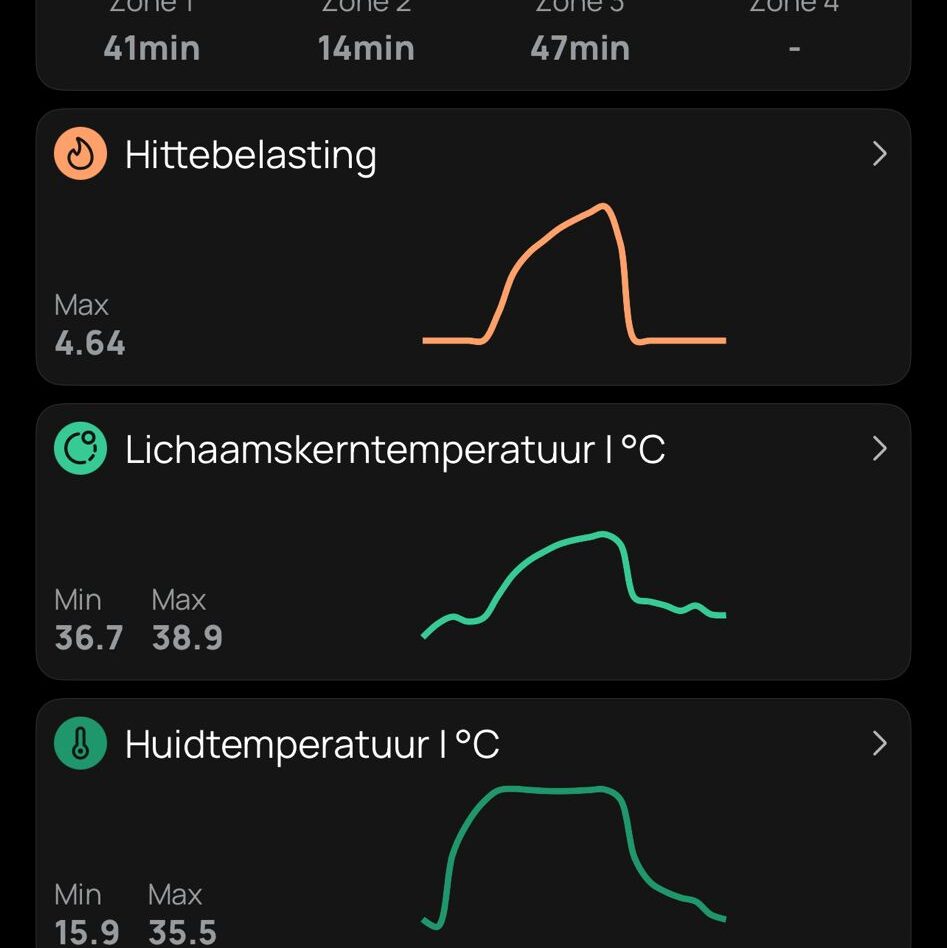
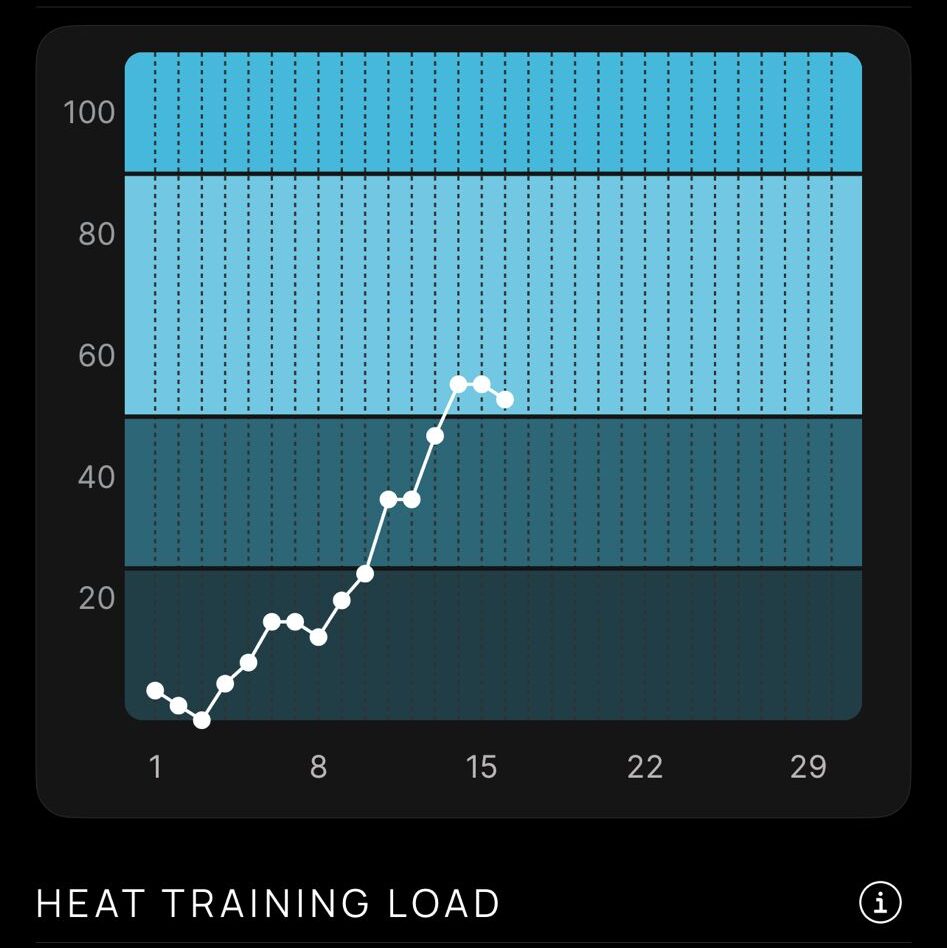
In the app, you can see how much time you spend at a specific HSI. The HSI scores are set into zones, with HSI 0-1 as zone 1, HSI 1-3 as zone 2, HSI 3-7 as zone 3, and HSI 7-10 as zone 4. The sweet spot for heat training lies at zone 3. Extended periods at zone 2 (multiple hours) also provide a heat benefit, but this is an inefficient way to provide a stimulus. Zone 4, which I personally never reached while measuring, would be considered dangerously hot. It is best to not train untill the point where your body reaches those temperatures. For a normal heat session you should aim for about 30-40 minutes in zone 3, up to maximum 60 minutes if you are well-adapted. It takes some time to get warm enough, resulting in most heat trainings lasting between 60 and 90 minutes. The time spent at certain heat zones correlates with the heat training score, a number between 0 and 10 that tells you how impactful the heat session as a whole was. For higher heat training scores, your heat adaptation score, a percentage between 0 and 100, increases more. If you take time off from heat training, your heat adaptation score decreases again.
Besides the heat trainings conducted while exercising, or active heat training, it is possible to do them while resting too: passive heat training. Think of saunas or hot baths. Staying in Finnish saunas of 80-90 degrees or baths with temperatures of 40-43 degrees for about 40 minutes does the trick. The benefits increase if you do these directly after exercise, entering the hot environment with an already elevated core temperature. In the CORE app you can input the conditions (e.g. water temperature, duration, and initial core temperature) and it gives you a heat training score in a similar way as if you would do an active heat training. You would think this is easier, as they do not involve physical exertion. Think again. In my opinion, passive heat training is much harder. The first 20 minutes are fine, but then the body starts screaming to get out. If you do not have a lot of time or do not want to add another training, the passive sessions are a great alternative. My personal preference is with the active sessions.
My own experiences with heat training
This season, I have mainly used CORE and heat trainings for acclimatisation purposes; preparing myself for the Arabian Warrior race in Al’-Ula, the OCR European Championships in Portugal, and the Spartan Beast World Championships in Abu Dhabi. Three important events, all three at locations and times of year where hot weather is more than likely. I conducted heat training for about 2-3 weeks before heading to the race venue, which was usually another week in advance. In total, this meant I exposed myself to 3-4 weeks of heat stimuli. I would aim for about 3-4 heat sessions per week, of which the vast majority active heat trainings. Sometimes I would make use of a Finnish sauna, but usually my passive heat sessions would be in a (very) hot bath. My first year with some dedicated heat training blocks was not without mistakes, but I have learned a lot from it. In the section below I discuss a list of my errors and tricks to ensure your heat training will be both safe and effective, because it is definitely possible to do it wrong and do a lot of effort in vain.
- Hydrate enough
This is quite logical, but do not underestimate the amount of fluid you need to consume during and after heat training. A guiding hand can be to stand on a scale (without clothes, they will hold the sweat and get heavier) before and after the heat training, keeping track of how much liquid you consumed. I easily lost up to 3 liters of sweat in a one hour session. Even if I managed to drink 2 liters, which is quite a lot, I still had to drink an additional extra liter afterwards to not be dehydrated for the rest of the day or night. Be sure to add some electrolytes to your water too. I usually had a bottle of regular sports drink, electrolyte water, and normal water. This variation makes it easier to drink a lot and ensures you replenish the minerals and salts that you sweat out. You might notice that when you do more heat sessions, you start to sweat more. This is your body adapting, and becoming better at cooling yourself. Although the amount of sweat increases, the amount of electrolytes does not. Your body gets more ‘efficient’ at sweating, losing primarily water. Focusing on sufficient electrolyte intake is thus most important for the first few sessions you do.
- Early in the day
Related to the topic above, but try to do the heat sessions as early in the day as possible. This is, of course, not always possible, but then at least be aware to replenish quickly and sufficiently after the training so you won’t wake up with a mouth dryer than the Sahara Desert. Furthermore, I personally felt that the heat training, even at low intensity, was such a stress on my body that sleeping shortly afterwards was almost impossible. I aimed to finish at 17:00 the latest, in order to sleep around 22:00. The sweet spot lies around noon or early afternoon, as early in the morning your body’s natural core temperature is lower than later in the day.
- Do not do 1 session and then 3 days nothing in the buildup, waste of energy
Heat adaptions, just like any training adaptions, take time and require consistency. If not stimulated enough, the body tends to move back to its baseline (e.g. not acclimatised). When you are doing your heat training buildup, try to keep maximum of 2-3 days of (heat) rest in between, preferably just 1. If you do a single session, and then only regular training for four days, the benefits of that session will almost completely be diminished. If you are at a high acclimatisation level, it is possible to maintain this for a longer period by only doing 2 or 3 sessions a week (ideal for multiple events somewhat close together). When building up, it will require a minimum of 3 sessions per week. I have wasted quite some energy in this way; squeezing in a heat session only to realize that due to, for example, travel it would take me too long before I would be able to get another session in. Maybe this still helps on a very low level, but in general I would recommend that when you start, you stick with it. Otherwise it might be wait with that first session untill you know you’ll be able to string a few of them together.
- Monitor heart rate
It is important to closely monitor your heart rate during heat training. Your heart rate will be significantly higher than under normal conditions, for me about 10-15 bpm. When you get used to heat training, your heart rate should get closer to normal levels. If the difference is really large, or your heart rate keeps on rising throughout the session, this might be a sign to stop the session. I pushed on during a heat session the day after my flight from Beijing, running 5min/km at 160+bpm, where normally I would be at 120bpm. I am pretty sure this delayed my recovery from the travel and time difference by 1-2 days. Besides having to adept my normal sessions, it took so long before I felt good enough to do another heat session that the effects of this initial sessions were long gone. It was all for nothing, because I did not pull the plug on time.
- Take heat ‘rest’ days
Do not go crazy and do heat sessions every day. Just like with high intensity training, you need to allow your body to recover in order to get the most benefits from the training. I sometimes did 3 heat sessions in a row, but never more. Normally, I would aim for 4 heat sessions per week, thus taking 3 days off. There is a two-week program which includes 12 sessions to get your body ready quickly for hot conditions, so it is possible to string together more heat sessions. It is just something that I have not tried yet. I prefer less sessions, but over a longer time. With that strategy, the heat trainings do not tire me out too much and the impact on my normal trainings is smaller.
- Crosstrain!
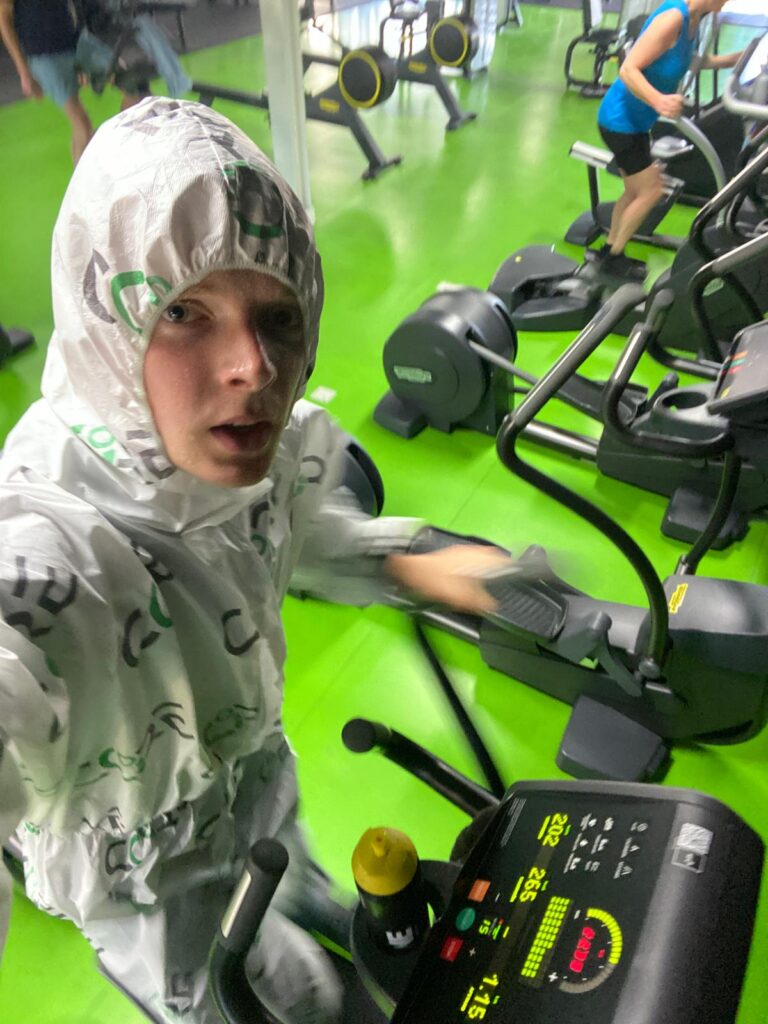
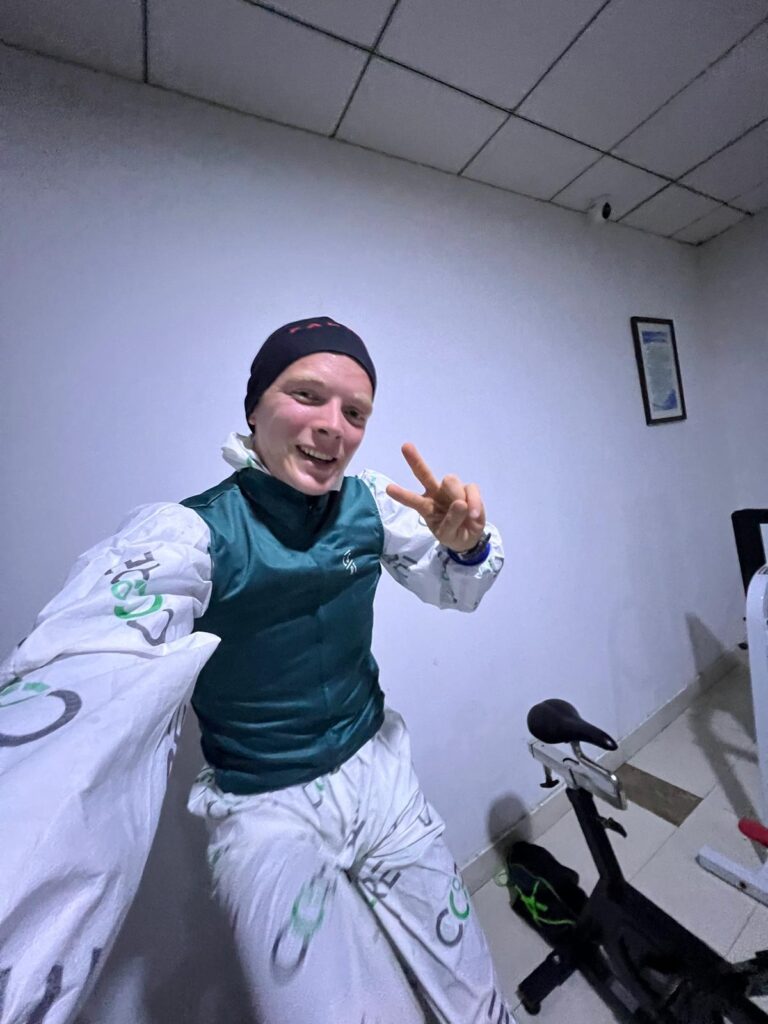
You can do active heat training in many ways, it is a perfect way to crosstrain. If you know me, you know I am a fan of crosstraining in general (mainly by cycling). As heat trainings are for me usually the second session of the day, I did almost all of my active heat training either on my bike (indoor) or an elliptical. Train in a way that works for you, but since you have to stare at a wall either way, it is a perfect way to provide a cardiovascular and heat stimulus that does not also stress the ligaments and bones like running does.
- Low intensity (but some higher tempo at the start)
Heat training should mainly be done at a low intensity. Although your heart rate might rise to a more medium zone, when looking at the output (pace/power) this should correlate to an easy effort. My treadmill running I did at around 4:55/km, which is slower than an easy run I would do outside. It can be helpful to do a few 1-2 minute intervals at a medium intensity at the start of the session to speed up the process of getting warm enough. I have never done a heat training with any real intensity. If I felt I was progressing and getting more comfortable, I would either dress up more heavily or extent the session a bit. During a heat training you can never do a really high quality session, so save that for the colder conditions. If you combine a normal session and a heat session (e.g. first an indoor right in your normal kit, and after 1 hour layering up for the final 45min), the higher intensity at the start is not necessary. Your body will already be warmed up inside, so when you overdress you should reach the correct heat zone relatively easily.
- Layer layer layer
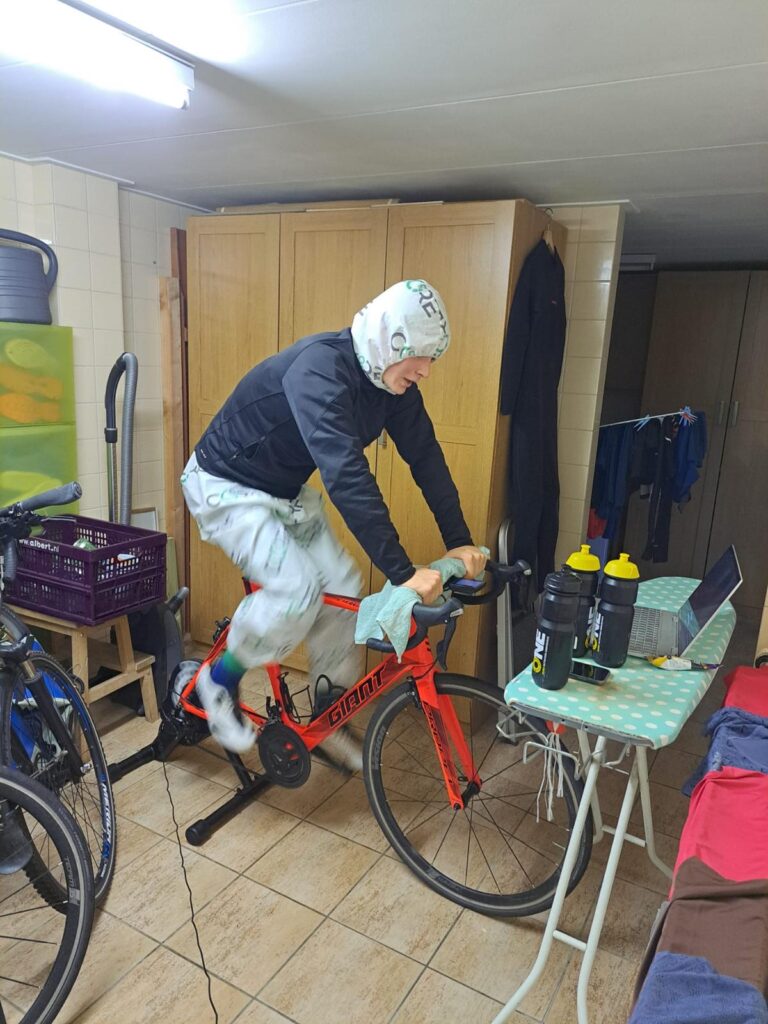
To get hot enough, and also to get hot quickly, you have to layer up. I personally struggle a bit to reach the right heat zone without many layers, so I tend to go a little bit crazy: long baselayers, waterproof layer (training pants and rainjacket), big hoodie, beanie, and sometimes gloves and another jacket. The baselayer serves as initial warmth generator on your body, while the waterproof layer traps the heat inside. The hoodie on top keeps you warm even as you get wet from all the sweat. You can lose a lot of warmth through the head and hands, hence the beanie. Gloves I don’t like so much, so I do not use them a lot. If I put on an additional jacket over the hoodie as well, I closely monitor the CORE app. When I have reached the right zone, I usually take of this fourth layer to ensure I don’t overstrain myself.
- Room temperature
The room you are training in does not have to be very hot, but make sure it is not chilly or with a lot of airflow. It will make reaching the appropriate heat zone much more difficult and longer. For me, it made the difference between reaching zone 3 in 25 minutes to 40 minutes. Believe me, it is very frustrating to look at your temperature values while sweating like a madman and seeing you are still not hot enough.
- Do them at home, or work on not getting embarrassed
Do the sessions at home, or accept that you look like a maniac. Nothing to do about it.
- Passive heat: baths, measure temperature
When doing passive heat training in a hot bath, invest (they’re cheap) in a thermometer. I bought something for a children’s pool. Do effectively do a passive heat training in your bath tub, the water needs to be hot (preferable 40C+). To make sure it is hot enough to start with, and also as time passes, you have to monitor the temperature. I usually had to renew part of my water every 5 minutes to make sure the temperature did not drop. As is the same with the active heat sessions, it is really not worth it to put yourself through the trouble of a hot bath if it is not quite hot enough to provide a significant stimulus.
Video from the Arabian Warrior race in Al’-Ula, Saudi Arabia. Temperatures during the race reached 43C.
- It is a shame to put in work, exert your body & mind and it is for nothing
And to prevent that from happening, buy the CORE sensor! Then you know what you are doing, ensuring you get hot enough (but not too hot). Furthermore, really listen to your body. If you are sleeping poorly or your regular trainings are not going well, consider reducing your heat load. If you cannot recover from the sessions, there is no use in doing them. I consider heat training an important part of my preparation for hot conditions, but it is the cherry on top. If I feel weak in my body, or haven’t been able to train well, but am well acclimatised, I will still perform at a lower level than a version of myself that is not acclimatised but in a top shape fitness wise.
Closing remarks
Heat training plays an increasingly important role in OCR, and endurance sports in general, as athletes are looking for additional gains to make. In OCR specifically its importance is rising, as more and more events are held in the middle east. The basics of heat training are simple, but you should take care when implementing it in your routine. Take into account the additional stress it puts on your body. To make sure your efforts do not go in vain, invest in the CORE sensor. Then you are sure you are training in the right zones and can manage your acclimatisation level over a longer time. If you have any further questions, feel free to send me a message or email.